
The Great Migration
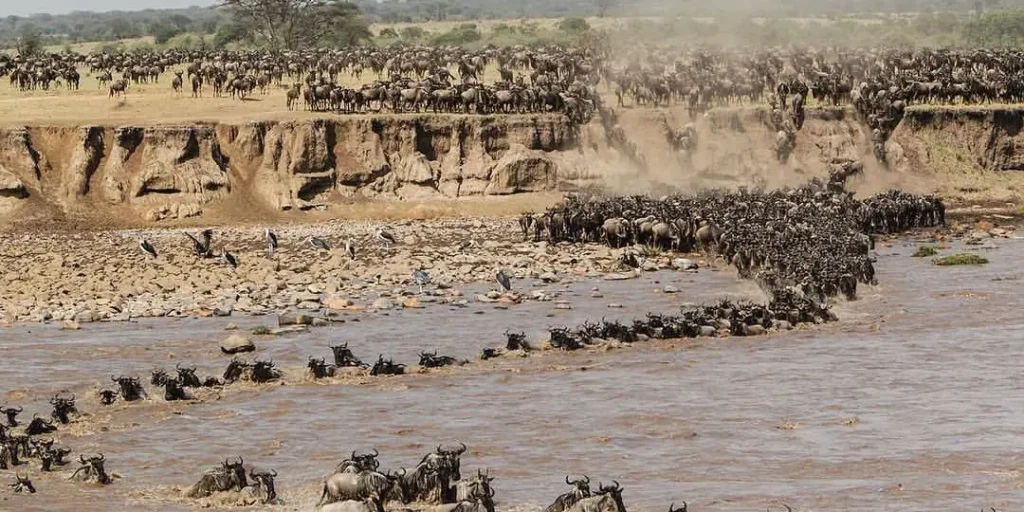
Every year, well over a million wildebeest, with hundreds of thousands of zebra and gazelle, follow the rains in a great loop through the Serengeti and Kenya’s Maasai Mara. It never stops: where you go depends on the month you travel.
Where the herds are, month by month
| Months | Where | What happens |
|---|---|---|
| December to March | Southern Serengeti and Ndutu | Calving season, usually peaking in February, with many predators |
| April and May | Moving through the central Serengeti | The long rains; green and quiet |
| June and July | Western corridor and central Serengeti | Herds gather; crossings of the Grumeti River |
| July to October | Northern Serengeti and the Maasai Mara | Mara River crossings |
| November | Moving south again | The short rains draw the herds back towards Ndutu |
This is the usual pattern, but the herds follow the rain, not the calendar, so timings shift from year to year. Our guides stay in touch with each other to find where the herds are each day.
Calving season
From about January to March, the southern plains become a nursery. Hundreds of thousands of calves are born within a few weeks, and lions, cheetahs and hyenas follow. It is one of the best times of year for predator sightings. See our 8-Day Wildebeest Calving Safari in Ndutu.
River crossings
From about July to October, the herds cross and re-cross the Mara River in the northern Serengeti, braving strong currents and crocodiles. Crossings cannot be predicted; you may wait for hours, or see several in a day. Two or three nights in the north give you the best chance. See our 8-Day Serengeti Wildebeest Migration Safari.
Why the migration matters
The migration is one of the last great movements of large mammals left on Earth, and it only works because the herds can still move freely across a huge, unfenced landscape in Tanzania and Kenya. Park fees, and the jobs that tourism creates around the parks, are a big part of what keeps that land open. Visiting in a responsible way, with patient guides who keep their distance at crossings, is part of keeping it that way.
Planning tips
- Book early for July to October and for February; the best-placed camps fill months ahead.
- Allow at least two nights in the right area of the Serengeti.
- Combine with Ngorongoro and Tarangire for a full picture of the north.
- Bring binoculars and, if you take photos, a zoom lens.
Questions before you book?
Our team in Tanzania is happy to help, whether you are still choosing or almost ready to go.
Our partners





Adventure That Gives Back
Private safaris, treks and beach holidays across Tanzania, planned by a Tanzanian team.
Forest Hill, Kihimbwa St, Morogoro, Tanzania
Talk to us
WhatsApp +255 622 191 154
ecolegacy@ecolegacy-africa.com
★ 5.0 on Google, from 2 reviews
Tourism licence No. 035908
Insured with Sanlam Allianz